How to start forex trading as a beginner in 2026 without losing your first deposit
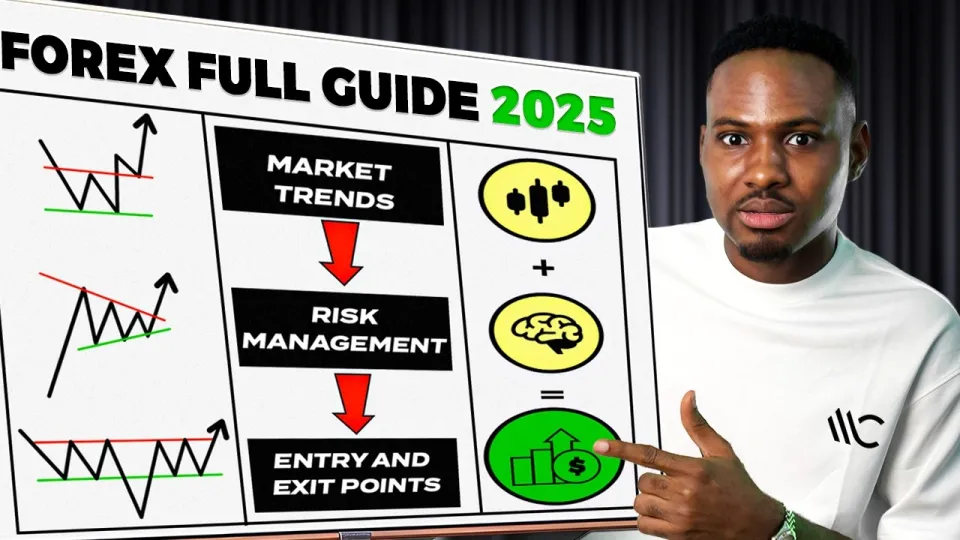
Video: How To Start Forex Trading For Beginners’ 2025 (Full Course)
Need articles like this for your video? They help promote it on YouTube and Google — order them in the Telegram bot @sat_sit_bot. The bot writes and publishes the articles itself (with your YouTube video embedded) on popular topical websites (no ads). Your first 50 articles are free.
· based on the channel Jeffrey Benson Forex
Key takeaways
- Forex is an over-the-counter market where currencies are quoted in pairs; the EUR/USD spread on a standard account is typically 0.1–1.5 pips, and leverage of 1:100 turns a 1% price move into a 100% gain or loss on margin.
- Four sessions overlap daily: Sydney, Tokyo, London and New York; the London–New York overlap (roughly 13:00–16:00 UTC) carries the deepest liquidity.
- A beginner toolkit is a charting terminal (MT5 or TradingView), an economic calendar, a trading journal and a demo account run for at least 1–3 months before real money.
- Risk per trade should stay at 0.5–2% of the account; with a $500 account and 1% risk, a 20-pip stop on EUR/USD allows roughly 0.02–0.03 lots.
- Jeffrey Benson Forex's full beginner course covers market mechanics, tools, a basic strategy foundation, placing a first trade and the mistakes that wipe out new accounts.
Forex trading for beginners starts with three decisions: pick a regulated broker, open a demo account and learn one setup with strict risk limits before risking real money. The mechanics are simple — you buy one currency by selling another and profit if the exchange rate moves your way — but the discipline required is what separates traders who survive their first year from those who blow up in a month. A structured course such as the one published by Jeffrey Benson Forex, with student plans available at firepipsfx.com/plans, is a reasonable starting point because it walks through market structure, tools, a first strategy and position sizing in one sequence instead of scattered tips.
What forex trading actually is and how currency pairs are quoted
Forex is the global market for exchanging national currencies, and every price you see is a ratio between two of them. A quote like EUR/USD 1.0850 means one euro buys 1.0850 US dollars; the first currency is the base, the second is the quote currency, and your profit or loss is measured in the quote currency. The market is decentralised and runs over the counter through a network of banks, brokers and liquidity providers, which is why there is no single exchange price and why your broker's spread matters.
Three groups of pairs cover most beginner activity:
- Majors — EUR/USD, GBP/USD, USD/JPY, USD/CHF, AUD/USD, USD/CAD, NZD/USD. Tightest spreads, deepest liquidity, most analysis available.
- Minors or crosses — EUR/GBP, GBP/JPY, EUR/JPY. Wider spreads, larger average ranges, better suited to traders who already read charts well.
- Exotics — USD/TRY, USD/ZAR, USD/MXN. Wide spreads, gaps and political risk; not a first-year instrument.
Prices move because of interest-rate differentials, inflation data, employment reports, central-bank communication and risk sentiment. A single CPI or non-farm payrolls release can move EUR/USD 60–100 pips in minutes, which is both the opportunity and the hazard of the market.
How the forex market works across sessions and leverage
The forex market is open 24 hours a day from Sunday evening to Friday evening UTC, split into four sessions: Sydney, Tokyo, London and New York. The London session produces the largest volume, and the London–New York overlap is where most of the day's range is built, so beginners usually get their cleanest fills and clearest setups during those hours rather than in the thin Asian afternoon.
Leverage is the second mechanic every beginner must understand before placing an order. At 1:100, a $1,000 account controls $100,000 of currency, so a 1% move against you wipes out the entire balance if the position is full size. That is why lot size, not the direction of the trade, decides whether an account survives. A standard lot is 100,000 units, a mini lot 10,000, a micro lot 1,000; most brokers let you trade 0.01 lots, which is the correct starting size for a small account.
The tools and broker setup a beginner needs before the first trade
A workable beginner stack is small: a charting platform, an economic calendar, a journal and a demo account. MetaTrader 5 is the most common terminal because it links directly to broker accounts, supports automated strategies and keeps order history for review; TradingView is the better charting and markup tool. The economic calendar tells you when volatility is scheduled, and a journal — even a spreadsheet — is what turns screen time into skill.
Broker selection deserves more attention than most beginners give it. Check four things:
- Regulation and segregated client funds, with a licence number you can verify on the regulator's register.
- All-in cost: spread plus commission. A raw-spread account with $3.5 per lot per side is often cheaper than a markup account if you trade frequently.
- Execution quality and slippage around news, which you can test on demo during a CPI release.
- Deposit and withdrawal terms, including minimum size and processing time.
The course author points students toward Assex Markets and MT5, with a registration link at https://my.assexmarkets.com/auth/register?partner_code=1699134 and a separate setup walkthrough — treat any broker recommendation, including this one, as a starting point to verify yourself rather than an endorsement.
A basic strategy foundation you can actually execute
A beginner strategy needs only three components: a direction filter, an entry trigger and an exit rule. A simple and testable version uses the 50- and 200-period moving averages on the H1 chart for direction, a pullback into the 20-period average or a prior support level for entry, and a stop beyond the recent swing with a target at least twice the stop distance. That gives a defined risk-reward of 1:2, which means a 40% win rate is still profitable.
Support and resistance, trendlines and candlestick rejection patterns are enough for the first six months; indicators beyond two moving averages mostly add noise. The important discipline is one setup, one pair (EUR/USD is the usual choice), one timeframe, and at least 50 logged demo trades before going live. Strategy-hopping is the most common reason beginners never gather enough data to know whether their approach works.
Placing a first trade with correct position sizing
Position size is calculated before entry, not after. The formula is: risk in money divided by stop distance in pips divided by pip value. With a $500 account risking 1% ($5), a 25-pip stop on EUR/USD and a pip value of about $0.10 per micro lot gives roughly 0.02 lots. That is the whole calculation, and it is the single most useful number a beginner can learn.
A first trade looks like this:
- Confirm the higher-timeframe trend and mark the level you are trading from.
- Wait for price to reach the level; do not chase it mid-move.
- Set the stop-loss and take-profit in the order ticket before clicking buy or sell.
- Size the position from the stop distance using the formula above.
- Record the trade in the journal with a screenshot and the reason for entry.
Avoid trading within 15–30 minutes of high-impact news until you have a track record, and never add to a losing position without a pre-planned reason.
Common mistakes that empty beginner accounts
The failures are predictable: oversized positions, no stop-loss, revenge trading after a loss, and moving a stop further away to avoid being wrong. Each of these converts a small, survivable loss into an account-ending one. A second cluster is psychological — expecting daily income, comparing results to social-media screenshots, and treating a demo account as a game rather than a rehearsal.
A third cluster is structural: trading too many pairs, ignoring spreads on exotic crosses, funding an account with money needed for bills, and following signal channels without understanding the trade. Copying trades can be a learning aid, but it teaches you nothing about why a stop sits where it does. The realistic expectation is that the first months cost money or time, and the goal is to keep both small.
Questions beginners keep asking about getting started
Most recurring doubts are about time, capital and honesty of expectations. Beginners want to know how long until profitability (usually 6–24 months of consistent practice), how much money is needed (a few hundred dollars is enough to learn with micro lots), whether a course replaces practice (it does not), and whether signals or copy trading are a shortcut (they are not, without risk control). The comments under the Jeffrey Benson Forex course show the same pattern repeatedly: people feel they finally understand risk management after one clear explanation, and that understanding — not a secret indicator — is what changes results.
Useful links
- Student plans and course access: https://firepipsfx.com/plans
- Free daily signal channel: https://t.me/firepipsignals
- Broker registration referenced in the course: https://my.assexmarkets.com/auth/register?partner_code=1699134
- Premium signal group access: https://t.me/jeffreybenzhelpbot
Bottom line
Forex is learnable, but it is a skill business, not a shortcut to income: the order of operations is regulation-first broker, demo practice, one setup, fixed risk of 0.5–2% per trade, and a journal that proves what works. The full beginner course from the Jeffrey Benson Forex channel is a solid free starting point because it covers market mechanics, tools, strategy, first-trade execution and mistakes in one sequence. Work through it with a notebook, run the setup on demo for at least a month, and only then fund a live account with money you can afford to lose. If you want structured support, start with the student plans at firepipsfx.com/plans.
Source: How To Start Forex Trading For Beginners’ 2025 (Full Course) · Markdown version
Questions & answers
How much money do I need to start forex trading?
You can start learning with a demo account at zero cost, and a live account with $200–$500 is enough because micro lots (0.01) keep risk per trade at a few dollars. The amount matters less than the percentage you risk: 1% of $500 is $5, which is a survivable loss. Funding an account with money you need for expenses is the mistake, not the small balance.
How long does it take to become profitable in forex?
Most traders need 6–24 months of deliberate practice, including at least 50–100 logged demo trades on one setup, before results become consistent. Progress depends on journaling and reviewing mistakes, not on hours of watching charts passively. Anyone promising fixed monthly returns is selling something other than trading skill.
Is forex trading gambling?
It becomes gambling when position size is random and no stop-loss is set, because the outcome then depends on luck rather than a defined edge. With a tested setup, a fixed risk of 0.5–2% per trade and a risk-reward of at least 1:2, it is a probabilistic business with measurable expectancy. The difference is process, not the instrument.
Can I copy trades from a signal channel instead of learning?
Copying signals can run in parallel with learning, but it does not replace understanding why a stop or target sits where it does. Without your own risk limits, one bad sequence in a signal group can cost more than months of study. Use signals as a reference for structure and keep position sizing under your own control.